Archive for the ‘Book Summaries’ Category
Sunday, November 8th, 2020
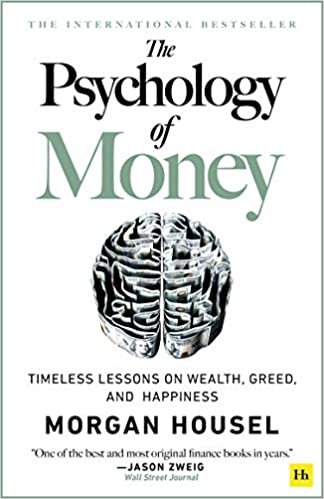
The Psychology of Money: Timeless Lessons on Wealth, Greed, and Happiness by Morgan Housel explains the psychology of spending and saving for anyone who has to deal with money and life. This is an excellent nontechnical study of this most important topic for high school students on up. If you want to acquire enough wealth to feel independent this book is for you. You can skip to chapter 20 to learn what Morgan and I do with our money.
Introduction
- We start with stories of a janitor who invested what he could in blue-chip stocks and died with an estate worth $8 million dollars and a successful businessman who went bankrupt by overspending on houses and wasting money. The premise of this book is that doing well with money has little to do with how smart you are and a lot to do with how you behave. It’s more about psychology and not so much about physics.
1. No One’s Crazy
- The decisions we make about money depend heavily on our experiences and the environment we grew up in. Although the first currency dates back to about 600 BCE, most of our current financial instruments only arrived after World War II. Prior to that time, most people worked until they died. Now we all expect to retire and have to save and invest for that day. Since modern instruments are so new, we aren’t crazy, we are just essentially newbies at it.
2. Luck & Risk
- Bill Gates attended a high school that had better computer access than most graduate schools. This allowed him to become an expert who wrote a program to do the school’s schedule among other things. Were it not for this unprecedented access he claims there would be no Microsoft. Meanwhile, his best friend who also became a computer wiz died in a mountaineering accident before he finished high school. The point here is that luck and risk are siblings. He shares other stories of people who took risks and made it big like Vanderbilt and Rockafellar who felt they had enough power to ignore some laws and indeed they did. Not all success is due to hard work and not all poverty is due to laziness. Keep this in mind when judging people. (Doug: Better yet, don’t judge people.) The world is too complex to allow 100% of your actions to dictate 100% of your outcomes.
3. Never Enough: When Rich People Do Crazy Things
- When you are young taking some modest financial risks makes sense as you have time to recover. At some point, you may need to decide that you have enough and scale back your risk. Morgan cites Bernie Madoff and Rajat Gupta as very successful investors who didn’t know when to say enough and ended up in prison after running a Ponzi scheme and engaging in insider trading. The ideas that the best games to play in a casino are none of them and that the Lotto is a tax on the poor are also instructive.
Posted in Book Summaries, Business Books, Education Books | Comments Off on The Psychology of Money by Morgan Housel
Monday, June 13th, 2016
50 Myths & Lies That Threaten America’s Public Schools: The Real Crisis in Education by David C. Berliner, Gene Glass, and Associates takes on many myths that have support amongst reformers and the media. This is a must read for anyone fighting the madness of our current test-and-punish school reform system. Give a copy to any policy maker you know.
Myths, Hoaxes, and Outright Lies
- “America’s public schools are being hijacked and destroyed by greed, fraud, and lies.” James Meredith – 1st black students at the University of Mississippi 10/1/1961. This quote sums up the purpose of this book. The authors limited themselves to only 50 and hope that readers will send in some more that do not appear herein. Myths are beliefs in things that may or may not be true. They fill in the void left by ignorance. The focus here is on myths that are untrue and that are having unhappy consequences. Hoaxes are different in that the person pushing them knows them to be dubious or untrue, but also knows that they will greatly benefit the pusher. Liars are different in that they don’t even believe what they are saying. Once again the lies are promoted for someone’s self-interest. The overridding myth is that America’s public schools have failed. The authors do an excellent job showing that this is not the case.
Myths and Lies About Who’s Best: Charters, Privates, Maybe Finland?
- The focus here are the international tests where the US usually ends up in the middle of the pack. This is where we have been since the first efforts at country sorting where made in the 1960’s so it’s not like we have gone downhill. If you sort out the poor kids our scores are at the top with countries like Finland where poverty is 5%. The fact that the tests are in different languages and use the metric system makes them less valid. Never the less, reformers have used these scores to promote unproven reforms.
- The same test scores are used to show that private schools are better than public schools, but once you take socioeconomic the status of the students into consideration, public schools do better. Private school students are wealthier and whiter. Teachers have more autonomy, better resources, and few students with disabilities and English language learners. They also have less violence and discipline problems as they can control who they accept and who they get rid of. While charter schools are actually public schools, they share many of the same qualities as operators can game the system to control their population. While comparing publics to charters is difficult, the evidence we do have indicates that publics do better. The big reason in my mind is that when compared to public school teachers, charter school teachers are less experienced, less likely to be certified, less well paid, and have higher turnover rates.
Posted in Book Summaries, Education Books, Leadership Books | Comments Off on 50 Myths & Lies That Threaten America’s Public Schools: The Real Crisis in Education by David C. Berliner, Gene Glass, and Associates
Monday, November 20th, 2023
A Guide for Interprofessional Collaboration Edited by Aidyn Iachini, Laura Bronstein, and Elizabeth Mellin would make a great textbook for any course on social work, which is a course that anyone who cares for individuals, families, or communities should take. The complex needs people face cannot be served by any one profession, which is why collaboration is essential. This book also belongs in any well-stocked professional development library.
Part I: Foundations
1. Relevant Contexts for Interprofessional Collaboration in the 21st Century: Social Issues, Settings, and policies
- Social work comes with many complex challenges. Addressing them cannot usually be achieved by social workers alone. Therefore, the social work profession is increasingly emphasizing interprofessional collaboration. Other professionals included are psychologists, counselors, doctors, educators, nurses, pharmacists, child welfare workers, and law enforcement among others. Bringing teams together often falls on the social worker. Collaboration is challenging, which is why many universities are now offering courses in interprofessional collaboration.
2. Exploring Definitions and Models of Interprofessional Collaboration
- There is a spectrum that extends from cooperation to coordination to collaboration. It goes from increasing levels of interdependance, structure, commitment, and risk. At the highest collaboration level services are co-located with multiple professions contributing to treatment.
- A second continuum goes from interprofessional to interdisciplinary. Multidisciplinary collaboration happens when professionals with similar backgrounds engage in mutual work. Mental health assessments are often multidisciplinary. Interdisciplinary collaboration occurs when boundaries between knowledge and expertise are blurred. Transdisciplinary collaboration occurs when boundaries are crossed, knowledge is exchanged and transformed into something new.
- The remainder of the chapter summarizes models that deal with the inputs, processes, and outputs of services.
3. A Model for Interprofessional Collaboration (MIC)
- The model used for the rest of the book is Bronstein’s Model for Interprofessional Collaboration (MIC). It contains five constructs. Interdependence involves people relying on each other to reach agreed upon goals. Everyone needs to understand everyone’s role and area of expertise. Newly Created Professional Activities are those that occur unexpectedly and are often thought of as synergy. Flexibility is necessary when rolls are blurred. Collective Ownership of Goals should involve everyone participating in goal setting, implementation, and evaluation. Reflection Process should take place thoughtfully and regularly.
- Beyond the five constraints, there are four things that influence the process. 1.Professional Role: Everyone needs to articulate their expertise and contributions. This will help avoid turf wars. 2. Structural characteristics deal with having time, space, and administrative support for collaboration. 3. Personal characteristics are important as collaborators need to like and trust each other. 4. History of Collaboration: Having a history of positive collaboration is important. This is why it needs to be a focus of classroom work and internships.
Part II: Putting the Model Into Action: Interprofessional Collaboration Across Settings and Populations
4. Education
- This chapter takes a look at a specific project where the team used the model from chapter 3. The project was called closing the broadband gap (CBBG). It was a university-school developed partnership aimed at addressing 1. using technology to engage students and enhance learning, 2. engaging parents in student learning, and 3. addressing the broadband access gap. The collaborators were social workers, the technology coach, teachers, administrators, business professionals, and parent engagement coordinators.
- As you read on you first encounter the five constructs followed by the four influencers. You are taken step by step through the project’s creation and implementation. You get to learn from the obstacles the team encountered. You learn that like many collaborations, the social worker is the link that holds the project together. By traversing this exemplar, you will better understand this important model that is worth using if you wish to collaborate on a meaningful project.
5. Criminal Justice
- This area brings courts, prisons, jails, and probation officers into the mix while keeping everyone else in play. Again, the social worker is at the center of the action. Here the MIC model follows the path of a young woman involved in the crimes of drug use and possession, shop lifting, and prostitution. This case is further complicated by having two children out of wedlock and a stressed relationship with her mother who has custody of the children. Many incarcerated people have multiple issues with things like drugs, mental health, economic insecurity, and employment. Employment is the key to getting these clients back in the game, but all of their other issues, including lack of education and skills get in the way.
- A key concept here is that the client has to buy into the plan, which means that the client must be involved in making the plan. It’s common for the clients to feel like a child as multiple collaborators are more or less telling them what to do. Further tension arises when the client fails to comply with the plan, often drug relapse, and the social worker shifts from advocator to law enforcer.
Posted in Book Summaries, Education Books, Leadership Books | Comments Off on A Guide for Interprofessional Collaboration Edited by Aidyn Iachini, Laura Bronstein, and Elizabeth Mellin
Wednesday, April 27th, 2011
In this book by Douglas Thomas and John Seely Brown, we find that the kind of learning that will define the 21st century will not take place in a classroom. It is happening all around us and it is powerful The growing digital network gives us nearly unlimited resources, while is connects us with others. Learning often takes place without books, teachers, or classrooms. Classrooms and teachers may not be obsolete, but the authors make a case that they must change.
© 2011 by Thomas and Brown ISBN-13: 978-1456458881
Tags: 21st Century Learning, A New Culture of Learning, Douglas Thomas, John Seely Brown
Posted in Book Summaries, Education Books | Comments Off on A New Culture Of Learning: What will define the 21st Century
Thursday, June 30th, 2011
This book by Richard Arum and Josipa Roksa draws on their extensive research. It shows that many undergraduates learn little or nothing when it comes to critical thinking, complex reasoning, and writing ability. The main reasons are generally poor academic preparation prior to college, and low expectations and demands in college. Rather than close the gap between high and low performing students, a case can be made that colleges increase the disparity.
Academically Adrift
- Limited Learning on College Campuses
- by Richard Arum and Josipa Roksa
- ©2011, University of Chicago Press: Chicago, Illinois
- Summary by Douglas W. Green, EdD
- DGreen@STNY.RR.Com
- If you like this summary, buy the book.
Arum and Roksa
- Richard Arum is a professor in the Department of Sociology with a joint appointment in the Steinhardt School of Education at New York University. He is also director of the Education Research Program of the Social Science Research Council and the author of Judging School Discipline: The Crisis of Moral Authority in American Schools. Josipa Roksa is assistant professor of sociology at the University of Virginia.
- The book addresses the question of how much undergraduates learn once they get to college. The answer here is not much. Richard and Josipa draw on their own research and many other sources to make their point. They find that a significant proportion of students do not improve when it comes to critical thinking, complex reasoning, or writing ability. This comes as no surprise to many who see students distracted by socializing and employment. They also see an institutional culture that puts undergraduate learning near the bottom of the priority list.
1. College Cultures and Student Learning
- Arum and Roksa cite the worry of middle-class parents over return on investment and concerns about quality by businesses as they look at college cultures that today feature more social activity and less time studying. Too many enter college with high ambitions and no clear plans for reaching them. They know little of their chosen occupations in terms of requirements of demands. They are essentially academically adrift. While study time is down to less than what they spent in high school, grades and progress toward degrees have seen little impact. Students preferentially enroll in classes where instructors grade leniently. For their part, faculty members allow students to get by with less effort. This brings better student evaluations and opens more time for research. Such evaluations are not good indicators of learning. Faculty are also rewarded for seeking external funding of which there is never enough at the expense of undergraduate attention. Administrators must also share the blame. An increase in student service positions has driven faculty percentage of professional staff down to 53%. At the same time, salaries of presidents, provosts, and deans has gone way up in spit of the fact that they are much less able to influence institutional climate than top executives in businesses.
Tags: Academically Adrift, Josipa Roksa, Richard Arum
Posted in Book Summaries, Education Books, Leadership Books | Comments Off on Academically Adrift: Limited Learning on College Campuses
Monday, August 19th, 2013
Adapt: Why SUccess Always Starts with Failure by Tim Harford offers an inspiring and innovative alternative to traditional top-down decision making. Tim deftly weaves together psychology, evolutionary biology, anthropology, physics, and economics along with compelling stories of hard won lessons from the real world. He makes a passionate case for the importance of adaptive trial and error to deal with problems both global, personal, and everything in between. Click at the bottom of any page to purchase this breakthrough handbook for surviving and prospering in an ever-shifting world.
Posted in Book Summaries, Business Books, Education Books, Leadership Books | Comments Off on Adapt: Why Success Always Starts with Failure by Tim Harford
Monday, November 19th, 2018
After the Education Wars: How Smart Schools Upend the Business of Reform by Andrea Gabor uses examples of successful and failing schools to demonstrate how the principles promoted by W. Edwards Deming can lead to school improvement. She provides extended histories of reforms in New York City, Massachusetts, Texas, and New Orleans to show how democratic grassroots reforms are more likely to work than the top-down approaches used in most states and cities. Everyone with the power to impact school reform needs to read this.
Introduction: The Quiet Revolution
- Andrea starts by reviewing the work of W. Edwards Deming and how he helped Japanese and then American companies modernize and improve. He found the blame to lie with top management and the answers to come from bottom-up reforms as employees closest to problems were in the best position to solve them. Unfortunately, the corporate-reform industry that has gained ever-increasing influence on how American schools educate children has largely ignored the strategies they used to improve production as they tinker with school reform.
- Business reformers came to the education table with belief in market competition and quantitative measures. Expertise from corporate boardrooms is favored over experience gleaned in classrooms. They also distrust of the education culture. It also came with arrogance, suspicion, and even hatred of organized labor. What is needed, however, is democratic collaboration, iterative improvement, and grassroots participation that is protected from bureaucratic meddling. We should value data as we understand its limits.
- Schools have different goals and cultures than businesses. This makes them less suited to being run like businesses. Three decades of top-down, corporate-style education reforms have proven deeply unpopular and have reaped few benefits. The number of bad teachers is also overestimated by reformers, but efforts to punish low performers has lowered morale and increased turnover. Other business practices like incentive pay have also had a negative impact. The only winners have been the testing and technology industries at the expense of a narrowed curriculum. This book will reveal what has worked, which should guide the next reform effort.
1. Big Dreams, Small Schools, How Entrepreneurial Rebels Built a Movement in New York City
- This chapter takes us through some history of New York City Schools from the 1960’s to relatively recently. It tells of how a number of schools gained success by being small and at the same time allowing teachers to pretty much run the schools. In a sense, they used Deming’s grass-roots ideas to interest students in the learning and act as role models. They shunned standardized testing and looked at other performance indicators. A sense of creative non-compliance pervaded these schools as they bent the rules and looked for cracks in the system. Classrooms were more open and curricula less fixed. There was lots of learning by doing, art, music, and field trips.
A new generation of educational leaders arrived who had no experience teaching. Rather than learn Deming’s principles like industry, they instituted top-down reforms. Even though they saw the success of small schools, they missed the rest of the factors that lead to success. This also included those involved with funding like the Gates Foundation. Unfortunately, the De Blasio administration has increased bureaucracy and shunned the flat organization models of successful schools.
Posted in Book Summaries, Education Books, Leadership Books | Comments Off on After the Education Wars: How Smart Schools Upend the Business of Reform by Andrea Gabor
Tuesday, August 10th, 2010
This book by Joe Tye uses a fictional format to explain why organizational culture is so important and how you can get the people you lead to help you create the kind of culture you want. My summary deals with the key concepts, but you need the book to access the compelling story and valuable appendix. This would be a good read for your entire team to discuss.
Click here to see my summary of All Hands On Deck.
Tags: Culture, Joe Tye, Leadership
Posted in Book Summaries, Business Books, Education Books, Leadership Books | Comments Off on All Hands On Deck – Culture Trumps Strategy – Joe Thy
Monday, August 15th, 2011
Alone Together: Why We Expect More From Technology and Less From Each Other(© 2011, Basic Books: New York, NY) is Sherry Turkle’s third book that explores our lives on the digital terrain. Sherry has conducted hundreds of interviews to gather her data. She explores how the technology that lets us do anything anywhere with anyone can drain us as we try to do everything everywhere and are always on call. She looks at how relentless connections lead to a new solitude and impacts our emotional lives. She also sees hope as people seek to sustain direct human connection.
Tags: Alone Together, Sherry Turkle
Posted in Book Summaries, Business Books, Education Books, Leadership Books | Comments Off on Alone Together: Why We Expect More From Technology and Less From Each Other
Friday, July 29th, 2011
Always On: How the iPhone Unlocked the Anything-Anytime-Anywhere Future and Locked Us In by Brian X. Chen (© 2011, Da Capo Press: Cambridge, MA), is an insightful look at technology’s all-in-one revolution and its consequences. Will we give more control to individual companies and sacrifice privacy and freedom in the process? This is the first book to take on the possible future that products like the iPhone may portend. Brian writes the regular Apple column for Wired Magazine. In order to write this book, Chen interviewed many of the top technology thinkers, innovators, and researchers.
Tags: Always ON, Brian X. Chen, iPhone
Posted in Book Summaries, Business Books, Education Books, Leadership Books | Comments Off on Always On: How the iPhone Unlocked the Anything-Anytime-Anywhere Future and Locked Us In