Archive for the ‘Book Summaries’ Category
Saturday, July 11th, 2020
Boys and Sex: Young Men on Hookups, Love, Porn, Consent, and Navigating the New Masculinity by Peggy Orenstein finishes what she started with Girls and Sex, which is also summarized here. Once again she has conducted many interviews with young men and experts in many fields to paint a picture of how the same social forces that impact girls impact boys. Like her book on girls, all parents, boys, and girls should read my summaries and then get the books.
Introduction: What About the Boys?
- For this book Peggy increased the sample size of the boys she interviewed to over 100 (She interviewed 72 for the Girls book.) Again they were in college or heading for college and represented a geographical, racial, and sexual orientation mix. Unlike the “Girls” book she included trans genders here. Although she is old enough to be their mother, she felt that they were generally more forthcoming than the girls. It was also much easier to get parent permission. While parents talk precious little to their daughters about sex, they talk even less about it with their sons.
1. Welcome to Dick School
- Nearlly all of the boys in the study had egalitarian views about girls, thought they were smart and had platonic female friends. This is fairly new. Their definitions of masculinity, however, are right out of the 1950s. They included emotional detachment, rugged good looks, sexual prowess, athleticism, and the potential for wealth. Showing emotions is what girls do, which is not a good thing for boys. The young men who most internalize these masculine norms are more likely to have: sexually harassed a girl, bullied other boys, been victims of verbal or physical violence, engaged in binge-drinking, caused a car accident, been painfully lonely, been less happy, fewer close friends, been depressed, and been suicidal. They clearly pay a big price for being manly as do those around them.
- Generally, boys only discuss emotions and feelings with girlfriends, sisters, and their moms. With women doing the emotional labor, boys end up stunted in a state of arrested development. Toxic masculinity deals with emotional suppression, disparagement of the feminine, and bragging about sexual conquest. This is prominent in the “jock culture” and featured in “locker room talk.” As a result, athletes are three times more likely to be accused of sexual misconduct. In order to see things like rape as ok or even hilarious, boys learn to disregard others’ feelings as well as their own.
2. If It Exists, There Is Porn of It
- The big takeaway here is that today’s children are guinea pigs in a massive porn experiment and assessing porn’s impact isn’t easy as very little research funding is directed its way. All of the boys admitted to watching porn and some admitted to watching a lot. Parents and educators need to understand that porn is where their kids get most if not all of their sex ed. Intentional searches usually start when boys are 12 to 14. This is when most start to masturbate as they watch.
- Watching porn is likely to cause young people to become sexually active sooner, to have more partners, to have higher rates of pregnancy, to be more sexually aggressive, to view women more negatively, and to engage in more risky and atypical sexual behaviors depicted in porn. It can cause less pleasure from partnered sex, concerns about penis size, and anxiety (erectile disfunction) when engaging in foreplay.
- Perhaps main-stream media is more to blame as the scripts boys consume from childhood continuously objectify, demean, and are hostile or indifferent towards women. Unlike porn, which the boys know is about as real as professional wrestling, movies and TV shows are much more believable. Women in the business are often harrassed. The same is true for hip-hop music, the most popular music genre in the US who’s most devoted fans are typically white, suburban boys who are unlikely to know any black people.
3. Are You Experienced? Life and Love in a Hookup Culture
- Hookups presume a lack of connection and commitment although it can be the first step toward a relationship. Physical intimacy is the precursor to emotional intimacy if it happens at all. This is just the opposite of what most people experienced in previous generations. What happens during a hookup is rather vague. It can be anything from making out on the dance floor to intercourse. Some boys never engage in it while others do so every week. It is most common among affluent, white heterosexuals, and predominant in Greek life.
- Hookups are embedded in a school’s drinking culture. “Pre-game” afternoon drinking even when there isn’t a game leads to an evening of more drinking so when it’s time to hookup, both parties are often “hammered.” Boys are often told to ask permission prior to engaging in sex and to make sure the girl isn’t too drunk to know what she is doing. Hookup culture aligns with the values of contemporary masculinity: conquest over a connection, sex as status-seeking, and partners as disposable. Even for boys, they can be an emotional minefield causing inadequacy, anxiety, insecurity, confusion, disappointment, and embarrassment. There is a lot of peer pressure put on boys to hookup and brag about it. If boys understand this, at least they can make educated choices.
Posted in Book Summaries, Education Books, Leadership Books | Comments Off on Boys and Sex: Young Men on Hookups, Love, Porn, Consent, and Navigating the New Masculinity by Peggy Orenstein
Sunday, October 13th, 2013
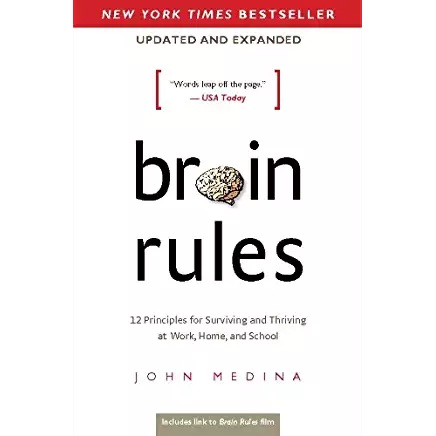
Brain Rules: 12 Principles for Surviving and Thriving at Work, Home, and School by John Medina tells how what we know about brain science can be used to positively influence our daily lives. This book is vital for educators, policy makers, and anyone who wants to get more out of their gray matter. Click at the bottom of any page to purchase this essential book.
Dr. John Medina
- John is a developmental molecular biologist focused on the genes involved in human brain development and the genetics of psychiatric disorders. Most of his life has been spent working in the biotechnology and pharmaceutical industries. He teaches at Seattle Pacific University where he is the director of the Brain Center for Applied Learning Research. He also teaches in the bioengineering department at the University of Washington. His other books include Brain Rules for Baby, The Genetic Inferno, as well as books on Alzheimer’s, depression, and AIDS.
The Brain is an Amazing Thing
- The human brain is easily the most sophisticated information-transfer system on Earth. As you read this, it sends jolts of electricity crackling through hundreds of miles of microscopic wires in less time than it takes to blink. Brain scientists have a lot to learn, but they rarely have conversations with educators and business people. This book is meant to fill this communications void. Each of the 12 rules here are supported by research that has been replicated, and John focuses on how what we know can be applied to our daily lives.
Posted in Book Summaries, Business Books, Education Books, Leadership Books | Comments Off on Brain Rules: 12 Principles for Surviving and Thriving at Work, Home, and School
Wednesday, October 19th, 2011
Reform your science program one activity at a time with Dr. Thomas O’Brien’s three volume Brain-Powered Science: Teaching and Learning with Discrepant Events effort for grades 5-12. It is a cerebral treat for science teachers, science students, and science teacher educators alike. At the heart of each activity is a hands-on discrepant-event, which provides an unexpected outcome. This generates a need-to-know that motivates learners’ to think and often makes science fun and funny. The activities are safe, simple, inexpensive, enjoyable, effective, and relevant. Teachers who use these activities should also find that they serve to open their own doors to learning. In all cases there is a deep connection to recognized national science education standards. (Brain-Powered Science, (© 2010) More Brain-Powered Science, (© 2011), and Even More Brain-Powered Science, (© 2011) are published by the NSTA Press: Arlington, VA.)
Tags: Brain-Powered Science, Discrepant Events, Thomas O'Brien
Posted in Book Summaries, Education Books, Leadership Books | Comments Off on Brain-Powered Science Reform Your Science Program
Monday, January 15th, 2024
Building Thinking Classrooms in Mathematics Grades K-12: 14 Teaching Practices for Enhancing Learning by Peter Liljedahl offers a whole new way to teach math that gets students thinking rather than mimicking the teacher’s sample problems. The vast research Peter did to discover his new methods is impressive as are student results. Consider having all of your math teachers read this summary and discuss it at a department meeting. Then give each a copy of this trailblazing book.
Introduction
- After observing 40 math teachers in 40 schools, Peter discovered that their practices were pretty much the same and that students spent little or no time doing the right kind of thinking. Unfortunately, the resources and textbooks available facilitated this non-thinking practice, which means that the problem is systemic. He also found that institutional norms were enabling this behavior.
- Over the course of 15 years, Peter and his crew of 400 teachers in teams of 8 to 18 worked on the 14 factors that impact thinking. The factors are represented by the titles of chapters 1 though 14 if you want to know what they are now. In each case they looked at the common norm and tried to do just the opposite. After a lot of trial and error they found the optimal approaches described here. If you want to try their practices, implement chapters 1-3 at the same time. Then you can implement the remaining practices one at a time.
1. What Types of Tasks We Use In a Thinking Classroom
- Problem solving is when we do what we don’t know how to do. It is not the implementation of a well taught algorithm. Students will get stuck, do some thinking, and get unstuck. Routine tasks involve mimicking, which is not thinking. There are examples of tasks here that require thinking. They can be considered non-curricular tasks that do not map nicely to a list of outcomes or standards. Before you can get kids to think about the curriculum, you need to get them to think.
- There are three kinds of lessons. 1 Non-Curricular tasks 2 Scripted Curricular Tasks and 3 Circular tasks. The later just involve mimicking what the teacher does. Scripted curricular tasks asks the students to solve a problem before showing them how to do it. Start by reviewing prior knowledge and then ask a question that will extend prior knowledge. While you can just give non-curricular tasks and let the curriculum take care of itself, using them to prime thinking before switching to scripted curricular tasks is way better than type 3 teaching.
2. How We Form Collaborative Groups In a Thinking Classroom
- Student collaboration is important and can have a powerful impact on Thinking. Peter’s extensive research indicates that random groups perform much better than self-selected groups. The groups must be visibly random. That means the students can see that the teacher hasn’t rigged the grouping. Peter uses playing cards to do this as students seem to like picking cards.
- In grades K-2 use two students per group. From grades three on up use three in each group. Randomness will lead to more diversity in groups and shy students will profit the most socially. Don’t worry if your groups are porous, which means that they collaborate with each other. In secondary schools form new groups at the beginning of each class. In elementary schools form new groups after lunch and recess.
3. Where Students Work In a Thinking Classroom
- Peter’s research shows that for best results, student groups should be standing and writing on erasable surfaces. He prefers white boards, but blackboards, windows, or surfaces found in home improvement stores should work fine. You may have to retrofit your classroom, but it can be done inexpensively. The erasable surface encourages students to take more risks and standing features better posture.
- Only give one marker to each group and make sure the teacher has a different color so anything the teacher does write stands out. You want each member to do some writing and Peter suggests ways to encourage this. Groups should be able to see what neighboring groups are doing.
4. How We Arrange the Furniture In a Thinking Classroom
- Too much order or symmetry does not make for a relaxed atmosphere. The best results happen in classrooms where desks or tables face in different directions and there is no obvious front of the room. Move the teacher’s desk somewhere near the back and eliminate any furniture you don’t need. This will give groups standing around the perimeter more room.
- The teacher should move around to reinforce the idea that the room has no front. This will promote more student collaboration and less teacher talk. Turn off projectors or interactive white boards when not it use and don’t stand next to them when they are on. Get three inexpensive clocks so there is one on each wall.
5. How We Answer Questions In a Thinking Classroom
- There are three types of questions. 1. Proximity Questions are asked when the teacher is next to the student. They are usually 2. Stop-Thinking Questions. These questions ask if this is right or do we have to learn this? If you answer them they can stop thinking. The third type are 3. Keep-Thinking Questions. They are asked so that students can keep thinking. They might be clarification questions or questions about going farther with a task.
- The only questions you should answer are keep-thinking questions. When students ask the other types you can smile and walk away or tell them that you have confidence that they can answer the question themselves. You can also respond with questions like isn’t that interesting or show me how you did that? You can explain what you are doing to students after a week or two. You should let the parents know at the beginning.
Posted in Book Summaries, Education Books, Leadership Books | Comments Off on Building Thinking Classrooms in Mathematics
Friday, January 6th, 2017
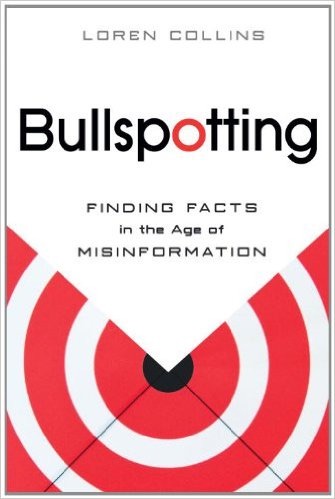
Bull Spotting: Finding Facts in the Age of Misinformation by Loren Collins will help you spot and avoid lies in a world with more accessible truth and lies than ever. In the age of fake news you can learn how to use the tools of critical thinking to identify the common features and trends of misinformation campaigns. Loren will help you tell the difference between real conspiracies and conspiracy theories, real science from pseudoscience, and history from fantasy.
Loren Collins
- Loren is and attorney and firm associate with the Law Office of W. Bryant Greene, III, P. C. He is the creator of Barackryphal, a website that debunks the fallacies propounded by birthers regarding the birth and citizenship of President Obama. He has written for The Atlanta Journal-Constitution on the topics of misinformation and critical thinking.
1. Baloney Detection
- Operating in the world efficiently depends on one’s ability to identify crap, also known as misinformation. Today we are constantly bombarded with information, which makes crap detection more import than ever. We tend to rely on common sense, but recall that there was a time when common sense told our ancestors that the world was flat. It can be helpful, but we need to look to science to uncover the truth.
- Most of us are not conditioned to distinguish between good and bad sources. We favor information from sources we like and visa versa. We accept information that supports our beliefs, and doubt information that doesn’t. This is know as confirmation bias. Other biases include having our thinking impacted by how something is framed, and putting more weight on recent information.
- People evolved to spot patterns even when they don’t exist and to create stories, myths, to explain the patterns. The ancient Greeks, for example, created different Gods to explain how the world worked.
- A common feature of creative misinformation is the reliance of anomalies. The problem with this approach is that it doesn’t produce a cohesive alternative theory. The idea is that if you can undermine one detail of the consensus view you have disproved it. If you see this in action, it tends to be a good means of spotting misinformation. Occam’s razor tells us that the explanation that makes the fewest assumptions is most likely to be the correct one.
2. Denialism
- Denialism concerns the rejection of truth accepted by experts. In some cases popular opinion denies scientific facts. For example, a 2010 poll showed that 40% of Americans believe humankind was created in our present form less than ten thousand years ago. The primary tactic is to look for anomalies that can poke holes in established theories. Deniers do not advance a cohesive alternative theory that can be tested.
- When confronted with evidence, deniers will often say it is forged or fake. When evidence can’t be denied they may say that it means something else like the Nazi gas chambers were not used for mass killings. Fake experts are also associated with deniers. While they may have college degrees, the degrees are usually in unrelated fields. Subjective experiences and anecdotes are often treated as solid evidence.
Posted in Book Summaries, Business Books, Education Books, Leadership Books | Comments Off on Bull Spotting: Finding Facts in the Age of Misinformation by Loren Collins
Wednesday, July 20th, 2022
Can You Learn to Be Lucky? Why Some People Seem to Win More Often Than Others by Karla Staff explains in detail how you can increase your chances of being lucky and therefore successful. We all experience good luck and bad luck as we go through life, but with Karla’s help, we can make good luck more likely and take better advantage of it, and better survive and learn from our bad luck. This book belongs in every professional learning library.
Introduction
- This book is about navigating life’s hidden patterns. While there is no way to account for every variable influencing our situation, this doesn’t make the world entirely unpredictable. We need to see the world as understandable and manageable. If you feel unsure about your ability to handle the future, anxiety will follow. Regardless of your merit, frugality, and faith, elements of chance will always be part of your life. This is where luck comes in. A bias toward action, however, can help as doing nothing can lead to learned helplessness. You can’t stumble on to something good by sitting down.
1. Best in Show: Why Lucky Timing Is out of Our Hands
- Studies show that your chances of winning a subjectively scored event are better if you are judged near the end. They also show that prisoners get the best deals if they are judged right after lunch or a break. If you are part of a contest or are interviewing for a job, do what you can to be near the end of the process. Then do what you can to be memorable and emphasize what makes you special or unique. Frame losses as learning experiences and don’t take them personally. And if you want to score with the gender of your choice at a bar, stay until closing time.
2. The Charlie Brewer Principle: How That Warm, Fuzzy Feeling Leads to Luck
- The focus is Charlie Brewer whose father and grandfather were star quarterbacks. Is it any wonder that the coach looked to him to be his next quarterback? If you have some advantage due to your family’s circumstances be sure to leverage it. However, if you are rich and good looking you might get away with being a dick, but it’s not a good strategy in the long run. Charlie’s story deals with confirmation bias. This is a concept you need to understand on the road to luck.
- The other big idea here is availability. By consistently showing up you increase your chances to be lucky. If you are always there you will seem safe, which correlates with luck. The more people see you the more they are likely to like you as long as you are nice. Proximity counts. People who live on the bottom floor have more friends. Kids who sit in the middle of the room are more popular. Your attire is very important. For example, women who show up in a nightclub dress are not likely to be seen as highly capable. Make a good first impression and know that it takes time and effort to build a good reputation.
3. Bitches in Glasses: The Occasionally Unlucky Side of Intuition
- We use our feelings to decide and rationalize our choices after the fact. There are things we can control like grooming, attire, facial expressions, posture, what we say, tone of voice, and body language. We have some control over our body shape and size. We have little control over the shape of our face and our height, and they both count for more than they should. Be sure to act in a friendly manner and smile when you meet someone. Act like you are happy to see them. This you can control and it will help make a good first impression.
- We tend to map traits from people we know on to people we meet who look similar. The feelings we currently feel also impact our impression of the people we are with. Women who don’t smile are judged more harshly than men who don’t smile. People with square jaws and wider faces are more likely to be promoted. Life is indeed unfair. What you can do is throw your hat into the ring every chance you get, use an easy-to-pronounce version of your name, and avoid edgy jokes and weird online IDs.
Posted in Book Summaries, Business Books, Education Books, Leadership Books | Comments Off on Can You Learn to Be Lucky? Why Some People Seem to Win More Often Than Others by Karla Staff
Monday, January 4th, 2010
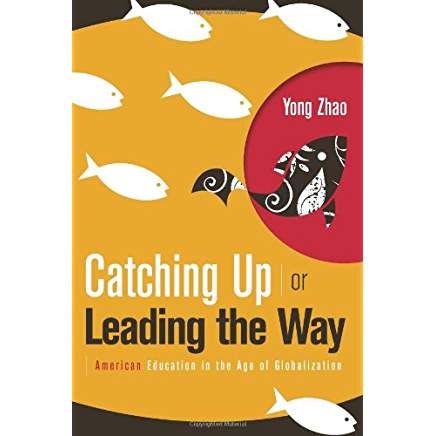
Catching Up or Leading the Way: American Education in the Age of Globalization by Yong Zhao (©2009, ASCD: Alexandria, VA) tells the story of how China seems to want an education that America seems eager to throw away. This is one that respects individual talents, supports divergent thinking, tolerates deviation, and encourages creativity. At the same time, the US government is pushing for the kind of education that China is moving away from. This is one that features standardization of curricula and an emphasis on preparing students for standardized tests. He wonders why Americans who hold individual rights in high regard would let the government dictate what children should learn, when they should learn it, and how they are evaluated.
Meet Yong Zhao
- Dr. Zhao grew up in China and immigrated to the US in the 1990’s. Yong Zhao is currently Presidential Chair and Associate Dean for Global Education, College of Education at the University of Oregon, where he also serves as the director of the Center for Advanced Technology in Education (CATE). He is a fellow of the International Academy for Education. Until December, 2010, Yong Zhao was University Distinguished Professor at the College of Education, Michigan State University, where he also served as the founding director of the Center for Teaching and Technology, executive director of the Confucius Institute, as well as the US-China Center.
Get My Kid Out of Here
- Zhao relates a story about his son who told him that he figured out how to get a better score on Michigan’s NCLB tests. His strategy was to stop being creative and imaginative. Instead he would follow the scoring rubric, that was analyzed and taught by his teacher. His score did improve but for this and other reasons the Zhaos decided to move him to a school that was not governed by NCLB.
- The most serious consequence of NCLB is that it leads to homogenization of talents. While the intention is to ensure every child receives a good education, the problem is that NCLB practically defines good education as being able to show good scores in a limited number of subjects. As schools conform to standardized curriculum, children are deprived of opportunities to develop talents in other areas. If it works, we will develop a group of individuals with the same abilities, skills, and knowledge. American needs a citizenry of creative individuals with a wide range of talents to sustain its tradition of innovation. Reforms aimed as saving America are putting America in danger.
The Two Gaps
- Two gaps are commonly cited as reasons why American schools need to improve. One is the performance gap between whites and minorities, primarily blacks and Hispanics. The other is the gap between average performance of American students and students from other first world countries. Zhao cites work by Berliner (2006) in pointing out that we didn’t need NCLB testing to tell us where to find failing schools since the common characteristic they share is poverty. There is strong evidence to support the idea that even a small reduction in family poverty significantly improves school behavior and student performance. Test bias also contributes. When tested for creative and practical abilities, minorities do much better.
Tags: education in China, Yong Zhao
Posted in Book Summaries, Education Books | Comments Off on Catching Up or Leading the Way Yong Zhao
Thursday, April 10th, 2014
Class Rank Weighs Down True Learning by Thomas R. Guskey – Phi Delta Kappan, March 2014, V95 N6, pp. 15-19. This is my summary of this fine article, which makes the point that teaching and grading schemes that work to select the most talented students often fail to benefit all students and to notice promising students. This may cause you to rethink what your high school is doing regarding this matter. Here is the link to the abstract. You will probably need a subscription if you want to view the full article, or you could hit your nearest college library.
Thomas R Guskey, PhD
- Thomas is a professor of educational psychology at the University of Kentucky. He is a graduate of the University of Chicago, and began his career in education as a middle school teacher. He served as an administrator in Chicago Public Schools, and was the first Director of the Center for the Improvement of Teaching and Learning, a national educational research center. He is the author/editor of 18 books and over 200 articles published in prominent research journals as well as Educational Leadership, Phi Delta Kappan, and School Administrator. You can find him on Twitter @tguskey or email him at guskey@uky.edu
Posted in Book Summaries, Education Books, Leadership Books | Comments Off on Class Rank Weighs Down True Learning by Thomas R. Guskey
Tuesday, October 16th, 2018
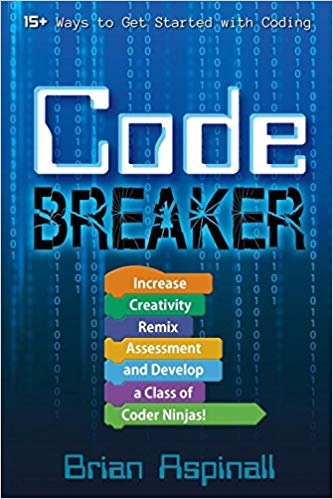
Code Breaker: Increase Creativity, Remix Assessment, and Develop a Class of Coder Ninjas! by Brian Aspinall shares his experiences and those of some colleagues in the process of teaching coding from kindergarten to high school. It deals with computational thinking which is a fundamental skill at the heart of engineering and mathematics. It includes coding and much more, and can even happen without technology. Make sure your school has a few copies.
Preface
- We live in an era of access as answers to knowledge-based questions can be quickly retrieved. As for coding, we have been teaching that in many forms since the 1960s. Like many, Brian is a self-taught coder. He offers ten reasons for teaching coding. They include building self-confidence, allowing students to create, self-expression, teaching storytelling, opportunities for risk-taking, reinforcing math principles, and teaching problem-solving. It is required for many future jobs, developing teamwork, and helping humanity.
1. The Clarity of Poop
2. A Wing and a Papert
- Here we get some learning theory. Assimilation happens when you incorporate new things into your current understanding. Accommodation happens when you learn new things and have to change what you currently understand. People learn best when they are involved in making or constructing things in the real world. To do this you need some control over your own learning. Learning should be concrete and computers are a good way to teach this. Computational thinking is a fundamental skill and it is at the heart of engineering and mathematics.
- Coding Rock, Paper, Scissors to Teach Probability
- Indigenous Trail: Trees and Coding a Micro:Bit Compass
- What Is Computational Thinking? Computational Thinking can take on a variety of forms.
Posted in Book Summaries, Education Books, Leadership Books | Comments Off on Code Breaker: Increase Creativity, Remix Assessment, and Develop a Class of Coder Ninjas! by Brian Aspinall
Tuesday, December 19th, 2017
Counting What Counts: Reframing Education Outcomes by Yong Zhao and friends takes on the current system with its focus on standardized tests and their sole focus on cognitive skills. Chapters are devoted to defining a variety of non-cognitive skills that are connected with success in life and the current status of how to assess them. They make a case for a new paradigm that would move the system towards more personalized learning and assessment with more focus on non-cognitive skills. Be sure to add this fine book to your professional development library.
Introduction – The Danger of Misguiding Outcomes: Lessons From Easter Island – Yong Zhao
- Yong uses the story of how the natives of Easter Island overexploited the resources in a race to build ever bigger statues. He compares this to the current race to produce students with excellent tests scores. Here he makes the case that the obsession with test scores has and will continue to damage our education ecosystem. It has resulted in cheating, teaching to the test, focusing on students on the pass/fail border, and limiting the focus on subjects not tested. We are destroying teacher autonomy as we ignore real challenges like poverty, unsafe neighborhoods, and unequal access.
- We are striving to produce a homogeneous population rather than supporting diverse talents. Routine knowledge and skills are stressed and they can easily be outsourced or automated. There are many negative side effects that are not considered unlike drug companies that must evaluate and publish side effects of their products. Creativity and non-cognitive skills are ignored. Students good at taking tests might not be good at anything else.
1. Numbers Can Lie: The Meaning and Limitations of Test Scores – Yong Zhao
- Humans are too complex to be reduced to a single number, and such numbers should not be used to make life-changing decisions. Research indicates that IQ tests have limited predictive power. Personality variables like high and stable self-esteem appear to be decisive for life success. SAT and ACT tests are much less predictive of college success than a student’s high school GPA. After many years, the Common Core Standards don’t appear to make students college ready, while motivation, time management skills, and awareness of postsecondary norms and culture do.
- A look at international tests shows that U.S. students have been bad at test taking for a long time. Such scores would suggest that by now the U.S. would be an economic backwater, but the facts suggest otherwise. It’s possible that countries that obsess about tests more than we do have discouraged the cultivation of creative and entrepreneurial spirits.
Posted in Book Summaries, Education Books, Leadership Books | Comments Off on Counting What Counts: Reframing Education Outcomes by Yong Zhao & Friends